






स्वस्थस्य स्वास्थ्यरक्षणम्
svasthasya svāsthya-rakṣaṇam
To protect the health of the healthy.
Charaka Samhita, Sutrasthana 30.26 (excerpt)
Everyday care, not cures. That is how we make soap.
Our craft
विधि
Cold-process soap, made the slow way
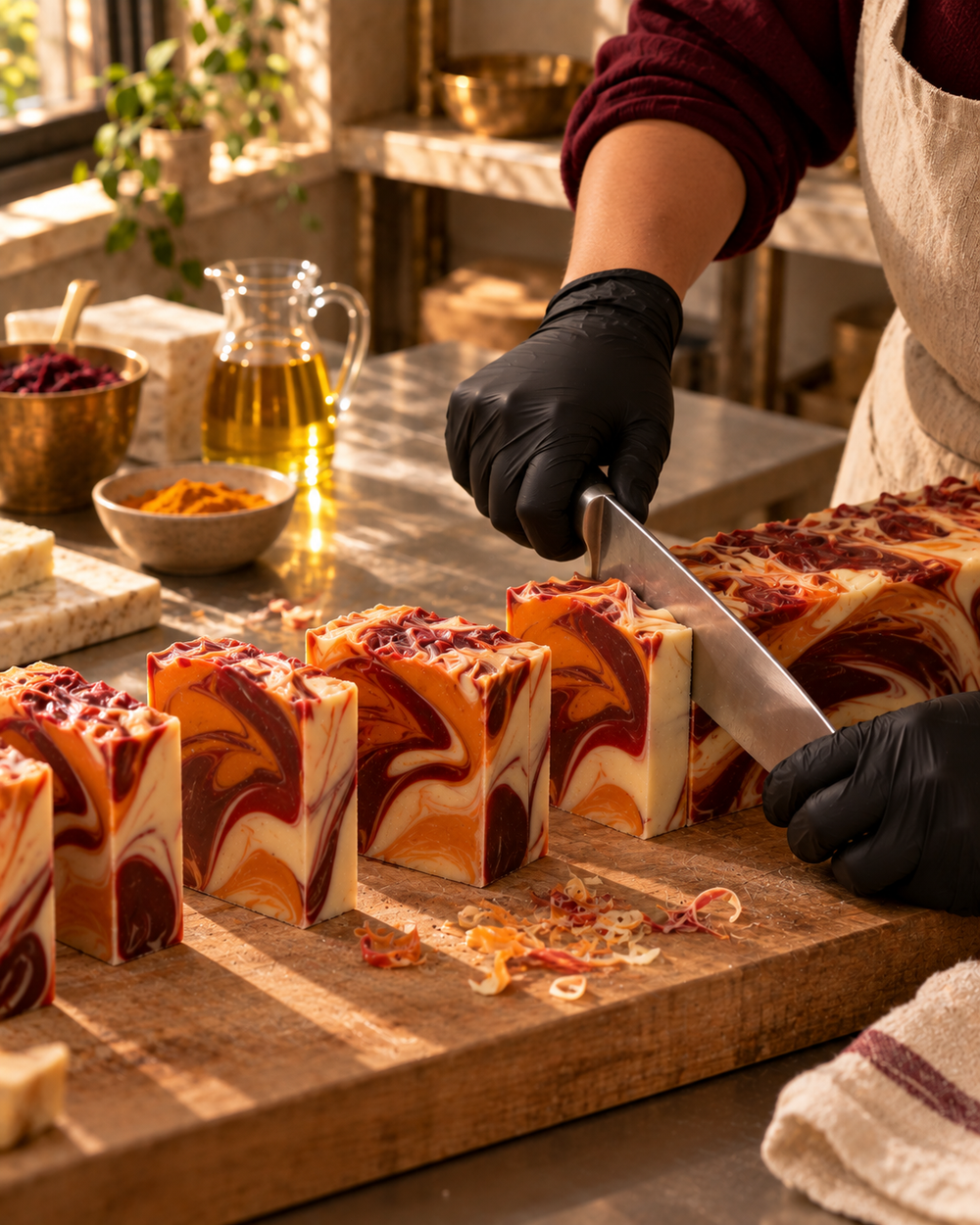
Every SetRite bar begins as oils and a little lye, which turn into soap through a slow reaction called saponification. We cut each bar by hand and let it cure for four weeks before it reaches you.
How a cold-process bar is made
It is called cold process because the soap is never cooked. The oils and lye do the work on their own, and time does the rest.
-
Oils meet lye
We start with a blend of oils. Lye, dissolved in water, is added and mixed in until the batter thickens.
-
The bar sets
The batter moves into moulds, where the reaction continues and it becomes solid soap.
-
Cut by hand
Once firm, the block is cut into bars by hand, so each one is a little different.
-
Cured for four weeks
The bars rest on racks while the last of the water leaves. They come out harder, longer-lasting and softer on the skin.
Cold process and melt and pour, side by side
Both are honest ways to make soap. They are different crafts, with different results.
| What we compare | SetRite cold process | Melt and pour |
|---|---|---|
| Starting point | Raw oils and lye, combined by us. | A ready-made soap base, melted down. |
| Who chooses the oils | We do, oil by oil. | The base maker does. You add scent and colour. |
| Glycerin | Forms during the reaction and stays in the bar. | Comes with the base. Some bases have extra added. |
| Time | Four weeks of curing. | Ready within hours. |
| The bar | Hard, and wears slowly in the shower. | Softer, and can sweat in humid weather. |
| Lather | Dense and creamy. | Varies with the base. |
Melt and pour suits quick, clear, decorative soaps. We chose cold process because we wanted to choose every oil in the bar and give it time.
द्रव्य
What goes into the bar
Four oils and two butters, each there for a reason. Here is what each one does in the bar and how it feels on the skin.
-
Olive oil
Olea europaea
The classic soap-maker's oil. Castile soap, made mostly from olive oil, has been made in Spain for centuries.
- Gives a mild, creamy lather
- Leaves skin feeling soft and conditioned
- Rich in oleic acid, the fatty acid behind that conditioning feel
- Makes a firm bar that lasts
-
नारिकेल
Coconut oil
Cocos nucifera
The oil that gives a bar its generous lather.
- Big, fluffy, cleansing lather
- Adds hardness, so the bar lasts longer
- Balanced by the softer oils in the blend
-
एरण्ड
Castor oil
Ricinus communis
Not a cleansing oil. It is there to look after the lather.
- Helps the lather stay creamy and stable
- Adds a smooth, conditioning feel
-
Sweet almond oil
Prunus amygdalus var. dulcis
A light, silky oil that glides on the skin.
- Leaves skin feeling soft
- Adds a gentle, conditioning feel
- Contains almond: not for anyone with a nut allergy
-
वृक्षाम्ल
Kokum butter
Garcinia indica
A firm butter from the seeds of the kokum tree, native to India's Western Ghats.
- Hardens the bar
- Feels light and non-greasy on the skin
-
Shea butter
Vitellaria paradoxa
A rich, creamy butter from the nut of the shea tree.
- Adds a creamy, cushioned feel
- Leaves skin feeling soft and conditioned
About the lye: lye is what turns oil into soap. It is used up in the reaction, so none remains as lye in the finished, cured bar.
As with any new product, patch-test before first use.
Caring for your bar
परिचर्या
How to use and keep your soap
A cold-process bar is harder and slower to wear than most. Treat it well and it lasts longer.
-
 1
Wet and lather
Wet the bar and work up a lather between your hands, or on a soft cloth.
-
 2
Rinse and shake off
Rinse well, then give the bar a gentle shake to remove the water.
-
 3
Rest it on a draining dish
Set the bar on a raised or slatted soap dish, so water drains from underneath.
-
 4
Keep it dry, away from steam
Store it in a dry spot, out of the direct spray and the shower steam.


The one rule
Let the bar dry between uses. A dry bar lasts longer.
As with any new product, patch-test before first use.

A family legacy
A legacy in soap. A new ritual in beauty.
SetRite begins with a family that has made soap for generations. Today that craft becomes an Ayurveda-inspired bathing ritual, made in small batches, with each bar led by a single note.
- 1952
Ramesh Sewak is born into a family associated with the Multani Soap Factory, and spends his life learning the craft.
- 2004
His son, Abhhishek Sewak, joins him. Together they look beyond everyday cleansing, towards soap, skin and the knowledge of traditional India.
- Today
SetRite brings that heritage to a new bathing ritual, inspired by Ayurveda.
Our Partners in Craft
Chosen by us. Crafted by hand.
SetRite is the family's selection of cold-process soaps. We choose each bar for its scent and character, and have it handcrafted in small batches with an artisan partner studio in Maharashtra. Every bar is cut by hand, so no two are quite alike.
- Our partner
- An artisan soap studio in Maharashtra
- Method
- Cold-process, cut by hand, in small batches
- Chosen by
- The Sewak family